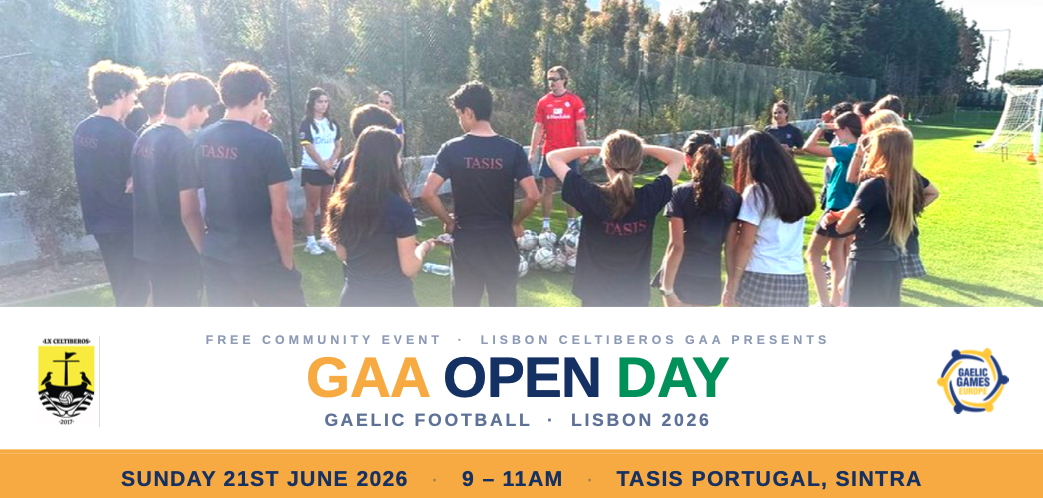
Free Open Day - Boys & Girls - All Ages - No Experience Needed
A calling to all Irish families, willing Gaels and anyone curious about Gaelic Games in the Cascais, Sintra & Lisbon area. Following GAA Ambassador Anton Tohill's schools & rugby clubs tour — 6 international schools and 2 rugby clubs visited in May 2026 — we're bringing the fun to the whole community. Children split into groups by age & ability. Parents who've played — or who just want to watch with a flask of tea — equally welcome. If all goes well, this could become a regular fixture and the seed of the LX Celtiberos Youth Club.
H E A D C O A C H
Eoghan Kerr
Tyrone native & TASIS teacher — coaching experience across Ireland, UK, USA, Middle East & Portugal. Supported by LX Celtiberos GAA members.
WHEN
WHERE — TASIS PORTUGAL
WHO CAN JOIN?
WHAT TO BRING
Equipment provided · Free entry
WHAT HAPPENS ON THE DAY?
FUTURE TRAINING
After-school and/or weekend training sessions available following the open day, subject to demand. Register your interest on the day or at gaa.pt.
Register: forms.cloud.microsoft/e/XaTrwS58Ni
Parking map: maps.app.goo.gl/CaR5ah8UQFEwpcKg9
Instagram: @gaa.celtiberos
WHAT IS GAELIC FOOTBALL?
Gaelic football is Ireland's national sport — one of the world's fastest and most skillful field games. Players can catch, kick, punch and run with the ball, shooting into a unique H-shaped goal (1 point over the bar, 3 points in the net). Teams of 15 play on a large grass pitch. No specialist equipment is needed — above all, it is enormous fun: perfect for children wanting to develop agility, teamwork and confidence in a welcoming, community-spirited club.
GAELIC GAMES — BOOMING ACROSS EUROPE
Over 110 clubs now play Gaelic Games across 18+ European countries, organised by Gaelic Games Europe (GGE). The annual European Youth Féile tells the story vividly: the inaugural tournament in Vannes, France (2022) had just 5 teams and around 50 children. By 2026 in Maastricht it had grown to 18 teams from 6 countries with 210+ young players — boys and girls in separate tournaments. In Galicia (Spain), the Gaelico Escolas programme coached close to 10,000 children in three years through school visits and teacher-training. Native Spanish players now outnumber Irish-born players at European competitions. Portugal is part of this movement.
Sign in to manage your membership and your orders.
No account yet?
One account for membership, events and the shop.
Already a member?
Match reports, training changes and the odd bit of news from the clubs. A few emails a month, and you can stop at any time.
